

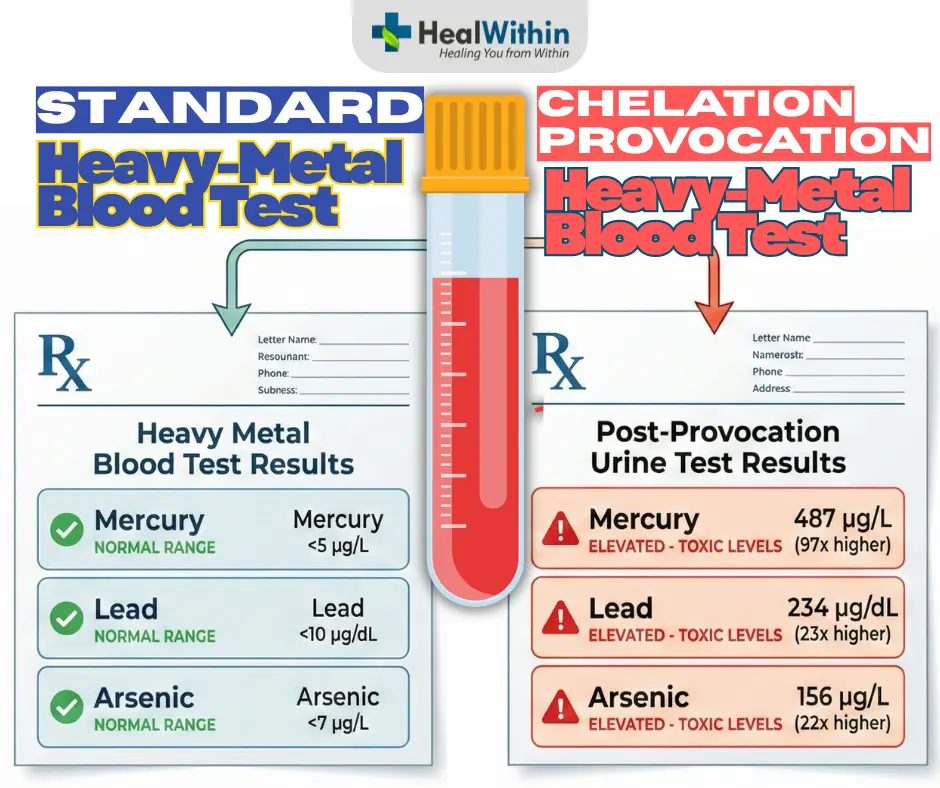
Have you ever been told your heavy metal blood tests are “normal” yet you still experience chronic fatigue, brain fog, or unexplained symptoms?
What if the toxic metals silently destroying your health are hiding in places where standard blood tests can never detect them?
Could your “normal” test results be missing the very toxins driving your chronic disease?
In my years of treating chronic disease patients, I’ve seen countless individuals receive normal heavy metal blood test results from conventional doctors, yet these same patients carried dangerous levels of mercury, lead, arsenic, and other toxic metals deep within their organs and tissues. The challenge is that standard testing measures only what’s circulating in blood at one moment, completely missing the accumulated metals stored in tissues where they cause the most harm.
Standard heavy metal blood tests measure less than 1% of your total toxic burden—only what’s floating in your bloodstream at that single moment. They miss the metals stored in your bones for decades, concentrated in your brain causing neurological symptoms, trapped in your thyroid disrupting hormones, and deposited throughout your organs driving chronic disease. Understanding why these tests have limitations—and how we expose hidden toxins through provocation testing—is key to addressing root causes rather than just suppressing symptoms.
Why Do Standard Heavy Metal Blood Tests Show 'Normal' Even When You're Toxic?
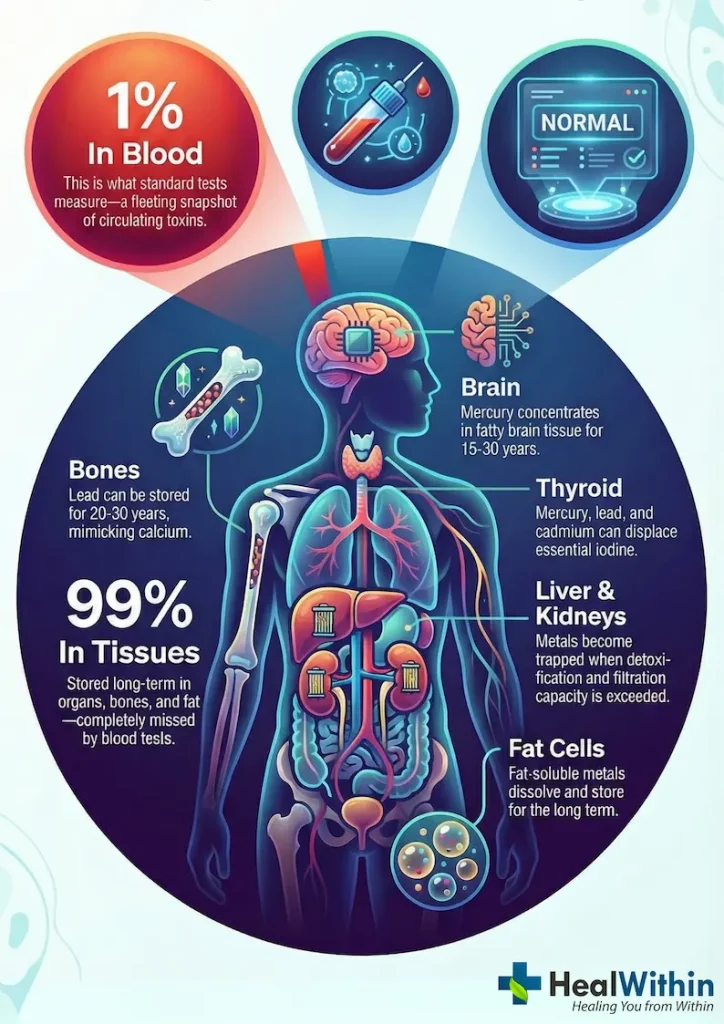
Standard blood tests for heavy metals seem logical—take blood, measure toxins, get results. But this approach has a fundamental flaw: it assumes toxic metals circulate in blood long enough to be measured. In reality, your body rapidly removes metals from blood and deposits them into tissues, making blood tests capture only a fleeting moment that reveals almost nothing about your true toxic burden.
HEAVY METALS DON'T CIRCULATE—THEY ACCUMULATE
Your bloodstream is a transport highway, not a storage warehouse. When heavy metals enter your blood, your body immediately removes them from circulation and sequesters them in tissues.
- Blood is a transport system, not a storage depot: Your bloodstream transports oxygen, nutrients, and toxins—but only temporarily. When heavy metals enter blood, your body immediately shuttles them out of circulation into tissue storage sites. By test time, accumulated toxins are no longer in blood—they’re locked in bones, organs, and fat.
- The body keeps blood “clean” at the expense of tissues: Your body treats the bloodstream as a priority system requiring relative cleanliness for immediate survival. Liver and kidneys frantically move toxic metals from circulation into storage depots throughout your body. This protective mechanism keeps blood levels deceptively low while tissue levels climb dangerously high.
- Standard tests only capture one fleeting moment: A heavy metal blood test measures only what’s circulating during the exact seconds blood is drawn—less than 1% of total body burden. It’s like checking trucks on highways to assess warehouse inventory—you’re measuring the wrong compartment entirely.
THE HALF-LIFE DECEPTION IN CONVENTIONAL TESTING
Heavy metals have drastically different half-lives in blood versus tissues—disappearing from blood within days while persisting in organs for decades.
- Metals clear from blood quickly but linger in tissues for decades: Mercury disappears from blood in 3-4 days but remains in brain tissue for 15-30 years. Lead clears blood in 30 days but stays in bones for 20-30 years. Blood tests normalize within weeks while toxins poison cells for decades.
- Chronic low-level exposure never registers in blood: Most people accumulate heavy metals gradually through amalgam fillings, contaminated fish, air pollution, and environmental sources—not dramatic poisoning events. Toxins deposit into tissues faster than they appear in blood, keeping blood tests perpetually “normal” despite mounting toxic burden.
- Timing determines results more than actual toxicity: Testing blood three months after removing mercury fillings typically shows “normal” levels—not because you’re toxin-free, but because acute exposure ended and your body already sequestered metals into tissues. This creates false reassurance precisely when danger begins its long-term assault.
CONVENTIONAL MEDICINE'S TESTING LIMITATIONS
The conventional approach to heavy metal testing focuses on acute, dramatic conditions rather than chronic, subtle toxicity.
- Blood tests detect acute poisoning, not chronic toxicity: Standard heavy metal tests were developed for emergency rooms and occupational medicine—identifying factory workers with massive exposures or children who ate lead paint. They were never designed to detect subtle, chronic toxicity driving most chronic diseases.
- “Normal” ranges reflect average population toxicity, not optimal health: Laboratory “normal” ranges come from testing large population samples and establishing statistical averages. In our toxic modern world, the “average” person already carries substantial toxic burden. Being “normal” means you’re as toxic as everyone else—not healthy.
- Medical training prioritizes lab values over clinical symptoms: Medical education emphasizes laboratory values as objective truth. When blood tests show “normal” heavy metals but you experience fatigue, brain fog, or chronic pain, most doctors dismiss concerns rather than question whether tests adequately measure tissue-stored toxicity.
Where Do Heavy Metals Actually Hide in Your Body?
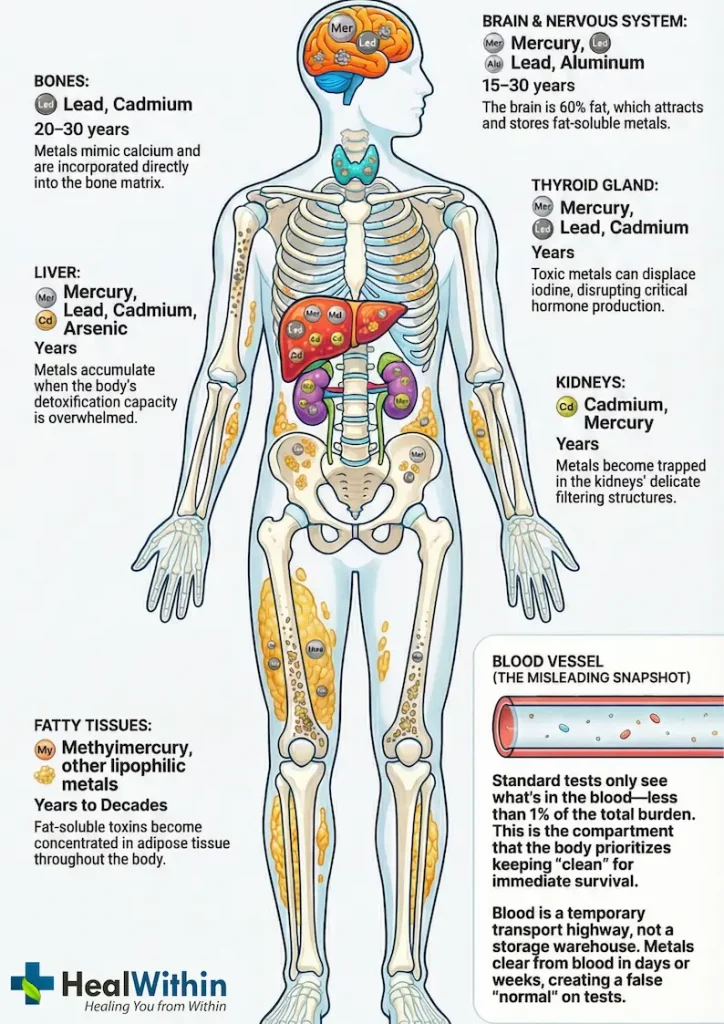
Heavy metals don’t distribute randomly throughout your body—they have specific affinities for certain tissues based on their chemical properties and the biochemical environment of different organs. Understanding where these toxins accumulate explains why blood tests miss them and why they cause such diverse symptoms affecting multiple body systems simultaneously.
PRIMARY STORAGE SITES FOR TOXIC METALS
Different heavy metals preferentially accumulate in specific organs and tissues where they remain for years or decades, causing localized damage that eventually manifests as chronic disease.
- Bones serve as long-term storage for lead and other metals: Your skeletal system stores toxic metals like lead for 20-30 years. Lead mimics calcium biochemically and incorporates into bone matrix. During bone turnover—pregnancy, menopause, illness, fasting—stored metals release back into circulation, creating symptoms years after initial exposure.
- The brain and nervous system concentrate mercury and other neurotoxins: Heavy metals like mercury, lead, and aluminum preferentially accumulate in fatty tissues. Your brain—being 60% fat—becomes a primary storage site where metals cross the blood-brain barrier, deposit in brain tissue, and interfere with neurotransmitter function, causing neurological symptoms from brain fog to neurodegenerative diseases.
- The liver, kidneys, and thyroid become toxic metal warehouses: Your detoxification organs don’t just process toxins—they accumulate them when toxic burden exceeds elimination capacity. The thyroid gland, rich in iodine receptors, inadvertently traps mercury, lead, and cadmium which displace iodine and disrupt thyroid hormone production, explaining hypothyroidism in many toxic patients.
FATTY TISSUES TRAP TOXINS AS WELL
Many heavy metals and their organic forms are lipophilic—they dissolve in fats rather than water—making fatty tissues throughout your body primary accumulation sites.
- Heavy metals are lipophilic and preferentially dissolve in fats: Many toxic metals and their organic forms like methylmercury dissolve readily in fats and oils. Your body fat, cell membranes, myelin sheaths, and adipose tissue become storage depots for these fat-soluble toxins. This explains why patients experience symptom flares during weight loss—fat breakdown releases stored toxins.
- Cell membranes accumulate toxins, disrupting cellular communication: Every cell membrane is composed of lipid bilayers that provide structure and regulate cellular transport. When heavy metals incorporate into membranes, they disrupt membrane fluidity, damage receptor sites, interfere with nutrient transport, and impair cellular communication, causing widespread cellular dysfunction affecting every organ simultaneously.
- Myelin sheaths in the nervous system are particularly vulnerable: Myelin sheaths insulating nerve fibers are predominantly fat-based structures enabling rapid electrical signal transmission. When mercury, lead, or aluminum accumulate in myelin, they cause demyelination—protective coating breakdown. This contributes to neuropathy, neurological symptoms, cognitive dysfunction, and nerve-related conditions.
THE TISSUE-BLOOD EQUILIBRIUM PROBLEM
Your body constantly attempts to maintain balance between blood and tissue concentrations of all substances, including toxic metals. For heavy metals, this equilibrium is achieved at dangerously low blood levels while tissue levels remain extremely high.
- Toxins move from blood to tissues rapidly but release slowly: Heavy metals move from bloodstream into tissues within hours or days. However, the reverse process—mobilizing metals from tissues back into blood for elimination—occurs extremely slowly, taking years or decades without intervention. This creates one-way accumulation where tissues become increasingly toxic while blood remains normal.
- The blood-tissue barrier protects blood at the expense of organs: Your body maintains barriers—blood-brain barrier, blood-thyroid barrier—regulating what enters sensitive organs. While protective, these barriers trap toxins once they enter protected compartments. Blood tests from your arm vein can’t measure toxins locked behind these barriers in brain, thyroid, or protected tissues.
- Equilibrium is achieved at dangerously low blood levels: Your body constantly works to maintain homeostasis—balance between blood and tissue concentrations. For heavy metals, equilibrium occurs when blood levels are very low (appearing “normal”) while tissue levels are very high. This protects blood quality for immediate survival but causes long-term tissue poisoning manifesting as chronic disease.
How Does Hidden Heavy Metal Toxicity Cause Chronic Disease?
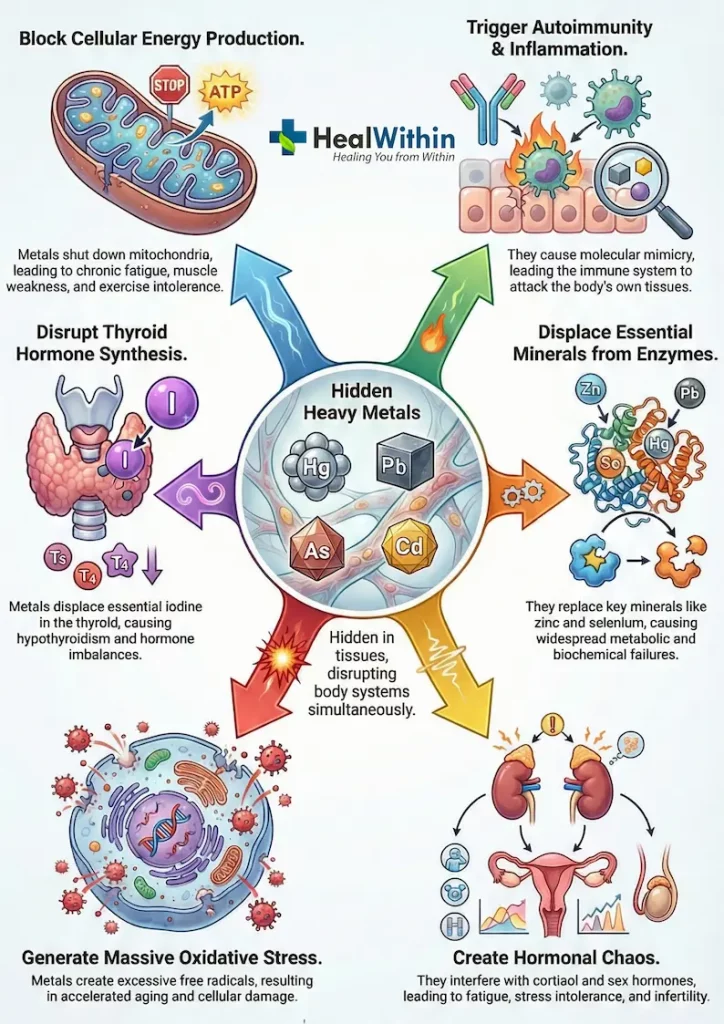
Heavy metals stored in tissues don’t just sit there harmlessly—they actively interfere with fundamental cellular processes throughout your body. This tissue-level toxicity creates the abnormal states in the 10 Pillars of Health that I’ve identified as root causes to all chronic diseases, explaining why patients with hidden metal toxicity develop such diverse and seemingly unrelated symptoms affecting multiple organ systems.
HEAVY METALS DISRUPT CELLULAR ENERGY PRODUCTION
Toxic metals directly attack your mitochondria—the cellular powerhouses producing energy for every function in your body. This explains the profound fatigue characterizing most chronic diseases.
- Mitochondrial dysfunction from toxic metal interference: Your mitochondria require specific enzymes and electron transport chains to generate ATP (cellular energy). Heavy metals like mercury, lead, arsenic, and cadmium directly bind to and inactivate mitochondrial enzymes, shutting down energy production. This manifests as chronic fatigue, exercise intolerance, muscle weakness, and exhaustion.
- Toxic metals displace essential minerals needed for energy metabolism: Energy-producing enzymes require specific mineral cofactors—magnesium, zinc, selenium, iron—to function properly. Heavy metals are molecular mimics that displace these essential minerals from enzyme binding sites. When lead displaces calcium, mercury displaces selenium, or cadmium displaces zinc, enzymes become non-functional and energy production plummets.
- Increased oxidative stress depletes cellular resources: Heavy metals generate excessive free radicals and oxidative stress within cells, forcing your body to expend precious resources—glutathione, antioxidants, energy—just neutralizing this damage. This creates a vicious cycle where cells use energy defending against toxins rather than performing normal functions, leading to cellular exhaustion and accelerated aging.
IMMUNE SYSTEM DYSREGULATION AND AUTOIMMUNITY
Hidden heavy metals create chronic immune activation and confusion, explaining why so many toxic patients develop autoimmune diseases alongside frequent infections.
- Heavy metals trigger chronic inflammation throughout the body: Toxic metals trapped in tissues create persistent inflammatory signals that chronically activate your immune system. This low-grade, systemic inflammation damages blood vessels, disrupts hormone balance, breaks down tissues, and creates the inflammatory environment underlying virtually all chronic diseases—heart disease, diabetes, autoimmune conditions, cancer.
- Molecular mimicry leads to autoimmune attacks: When heavy metals bind to proteins in tissues, they create altered protein structures your immune system doesn’t recognize as “self.” Your immune system produces antibodies against these metal-protein complexes, but these antibodies cross-react with normal body tissues having similar molecular structures. This molecular mimicry triggers autoimmune diseases like Hashimoto’s thyroiditis, rheumatoid arthritis, lupus.
- Toxic metals suppress immune function while triggering overactivity: Heavy metals create immune paradox—simultaneously suppressing certain immune functions (increasing susceptibility to infections and cancer) while triggering immune overactivity elsewhere (causing allergies, autoimmunity, chronic inflammation). This immune dysregulation explains why chronically toxic patients experience both frequent infections and autoimmune symptoms simultaneously.
HORMONAL IMBALANCES FROM ENDOCRINE DISRUPTION
Heavy metals interfere with hormone production, transport, and metabolism throughout your endocrine system, creating the hormonal chaos driving many chronic disease symptoms.
- Thyroid dysfunction from toxic metal accumulation: The thyroid gland is particularly vulnerable because metals like mercury, lead, and cadmium compete with iodine for binding sites on thyroid receptors and enzymes. This disrupts thyroid hormone synthesis (causing hypothyroidism), interferes with T4 to T3 conversion (creating inactive hormone dominance), and damages thyroid tissue (triggering Hashimoto’s autoimmunity).
- Sex hormone disruption affecting reproduction and vitality: Heavy metals interfere with production, transport, and metabolism of sex hormones—estrogen, progesterone, testosterone. Lead and cadmium have estrogenic effects disrupting hormonal balance in both genders. Mercury interferes with progesterone production and testosterone synthesis. This contributes to infertility, erectile dysfunction, menstrual irregularities, PCOS, endometriosis, low libido.
- Adrenal stress and cortisol dysregulation: Your adrenal glands work overtime helping your body cope with chronic stress of heavy metal toxicity. This constant demand eventually leads to adrenal dysfunction, cortisol imbalances, and symptoms associated with adrenal fatigue—inability to handle stress, blood sugar instability, sleep disturbances, anxiety, feeling perpetually overwhelmed.
How Does Heal Within Expose Hidden Heavy Metals That Standard Tests Miss?
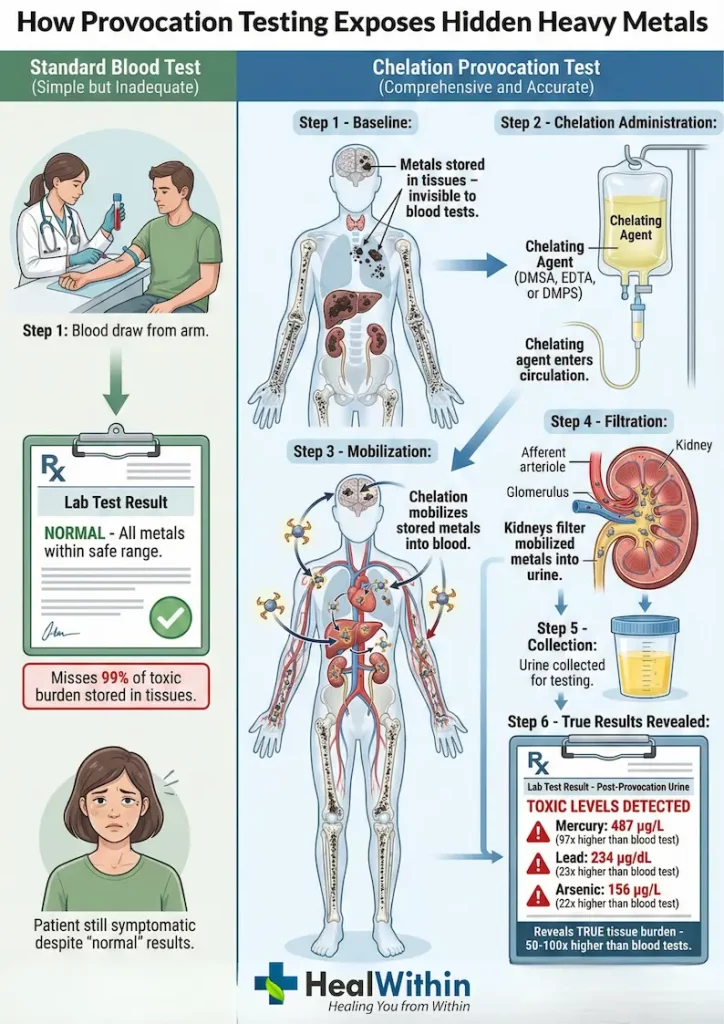
The key to detecting hidden heavy metal toxicity lies in actively mobilizing metals from their tissue storage sites into circulation where they can be measured. We use chelation provocation testing—a method that reveals the true toxic burden driving your chronic disease, providing the diagnostic information needed to design effective, individualized treatment protocols.
CHELATION PROVOCATION TESTING REVEALS TISSUE BURDEN
Provocation testing uses chelating agents to actively pull stored metals from tissues into urine or blood for measurement, revealing the hidden toxicity that standard blood tests completely miss.
- Chelating agents mobilize metals from tissues into blood and urine: Unlike standard blood tests measuring only circulating metals, we administer chelating agents—DMSA, EDTA, or DMPS—that actively bind to heavy metals stored in tissues and pull them into circulation for elimination. We then collect urine (or blood) for analysis, revealing true tissue burden that otherwise remains hidden.
- Provocation testing shows what’s actually stored, not just what’s circulating: Metals appearing in urine after chelation provocation represent mobilized tissue stores—accumulated toxins silently damaging organs for years or decades. This testing reveals mercury levels 50-100 times higher than baseline blood tests, lead levels 10-20 times higher, and significant levels of arsenic, cadmium, aluminum appearing completely “normal” on standard tests.
- This method is recognized by functional medicine doctors worldwide: Chelation provocation testing has been validated by thousands of integrative and functional medicine practitioners globally and is supported by scientific literature demonstrating its superiority over standard blood testing for assessing chronic heavy metal burden. It’s the gold standard in integrative medicine for revealing hidden toxicity driving chronic disease.
OUR COMPREHENSIVE HEAVY METAL ASSESSMENT PROTOCOL
We don’t just run one test and call it complete—we conduct comprehensive assessment before, during, and after treatment to ensure safe, effective detoxification tailored to your unique situation.
- Pre-treatment baseline testing establishes your starting point: Before beginning chelation or detoxification therapy, we conduct comprehensive baseline testing—standard blood levels, kidney and liver function, mineral status, and often provoked urine testing. This establishes your starting point, helps us understand your unique toxic burden, your body’s detoxification capacity, and which metals are your primary concern.
- Sequential provocation testing tracks mobilization and elimination: As treatment progresses, we perform periodic provocation testing monitoring how effectively metals are being mobilized from tissues and eliminated from your body. These sequential tests show whether your detoxification pathways are functioning optimally, whether we need to adjust chelation protocols, and document the gradual reduction in tissue metal burden correlating with your clinical improvement.
- Mineral status monitoring prevents depletion during detoxification: Chelation doesn’t just remove toxic metals—it can also bind essential minerals like zinc, magnesium, calcium. We carefully monitor your essential mineral levels throughout treatment and supplement appropriately to prevent deficiencies. This ensures that while removing toxins, we’re simultaneously optimizing nutritional status and supporting biochemical pathways needed for safe, effective detoxification.
WHY CONVENTIONAL DOCTORS DON'T USE PROVOCATION TESTING
The reasons provocation testing isn’t standard practice in conventional medicine reflect systemic limitations rather than scientific validity of the method.
- Conventional medical training doesn’t cover chronic heavy metal toxicity: Medical schools and residency programs focus heavily on acute heavy metal poisoning (which is rare) but provide virtually no training on chronic low-level toxicity (which is epidemic). Most conventional doctors have never learned about chelation provocation testing, don’t understand its clinical utility, and therefore dismiss both the testing method and the concept of chronic toxicity contributing to disease.
- Insurance systems don’t recognize or reimburse for comprehensive testing: The conventional medical system operates within insurance reimbursement models covering only “standard” tests approved by mainstream medical organizations. Since provocation testing falls outside these approved protocols, it’s not reimbursed by insurance, and doctors working within conventional systems can’t justify ordering tests patients must pay out-of-pocket.
- The system lacks profitable treatment pathways for heavy metal detoxification: The conventional medical system is largely oriented around pharmaceutical interventions generating ongoing revenue. Heavy metal detoxification through chelation, nutrition, and supportive therapies doesn’t fit the pharmaceutical model—there’s no patented drug to prescribe long-term, no specialist referrals, no surgical procedures. When there’s no profitable treatment pathway, there’s little incentive to test for the condition.
What Is the Integrated Treatment Approach to Heavy Metal Detoxification?
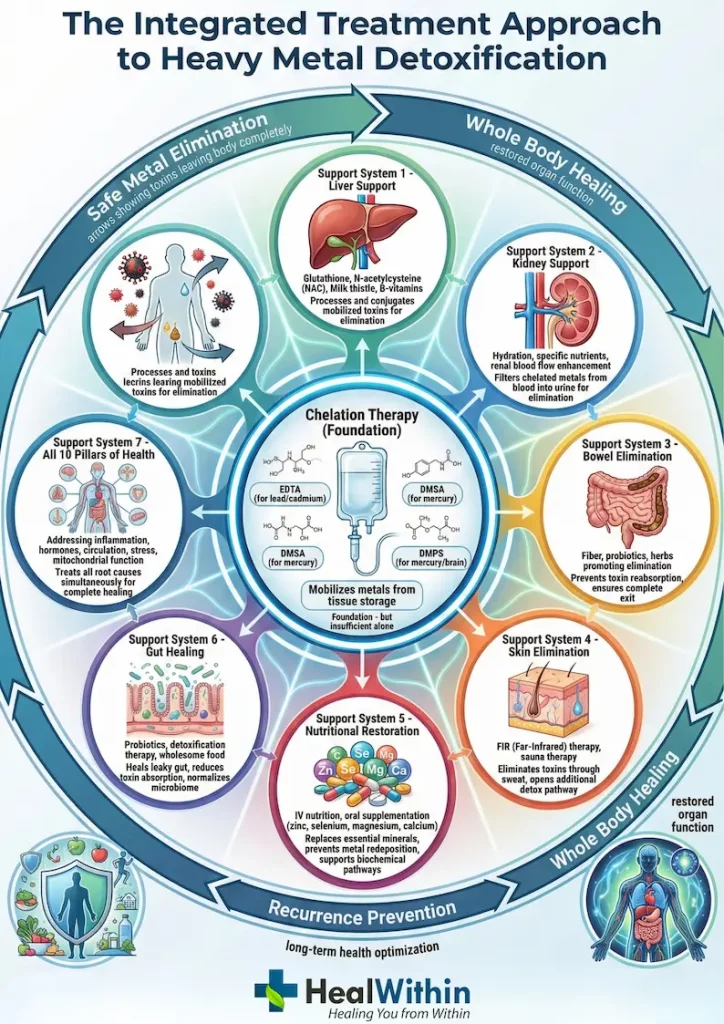
Removing heavy metals from your body requires far more than just chelation therapy alone. True healing demands a comprehensive, integrated approach that safely mobilizes toxins, supports all detoxification pathways, restores nutritional balance, and addresses all root causes simultaneously—not just the heavy metal toxicity but all the abnormalities in the 10 Pillars of Health that contribute to your chronic disease.
CHELATION THERAPY AS THE FOUNDATION
Chelation therapy is the cornerstone of heavy metal removal, but it must be administered properly with the right agents, protocols, and medical supervision.
- Multiple chelating agents target different metals and tissue compartments: We use various chelating agents—EDTA, DMSA, DMPS—because different chelators have affinity for different metals and access different tissue compartments. EDTA is particularly effective for lead and cadmium in the cardiovascular system. DMSA and DMPS excel at mercury removal and cross the blood-brain barrier to access nervous system. Using the right chelator for your specific metal burden ensures maximum effectiveness.
- Chelation must be administered safely with proper medical supervision: While chelation is highly effective, it must be done properly under medical supervision. Aggressive chelation in patients with compromised detoxification pathways can mobilize metals faster than the body can eliminate them, causing redistribution and worsening symptoms. We carefully assess kidney function, liver function, and detoxification capacity before chelation and monitor throughout treatment ensuring safe, effective metal removal.
- Treatment protocols are customized based on individual burden and tolerance: There’s no one-size-fits-all chelation protocol. Your treatment plan depends on which metals you carry, severity of burden, how well elimination organs function, symptom severity, and treatment tolerance. Some patients require gentle, gradual chelation over extended periods; others handle more aggressive protocols. This individualized approach ensures optimal results while minimizing discomfort.
SUPPORTING DETOXIFICATION PATHWAYS
Chelation mobilizes metals from tissues, but your body must eliminate them completely through liver, kidneys, bowel, and skin—otherwise toxins simply redistribute to other tissues.
- Liver support is essential for processing mobilized toxins: Your liver is the primary organ processing and preparing toxins for elimination. Before and during chelation, we support liver function through specific nutrients (glutathione, N-acetylcysteine, milk thistle, B-vitamins), detoxification therapies, and wholesome nutrition. A well-functioning liver ensures metals mobilized by chelation are efficiently conjugated, neutralized, and sent to elimination organs rather than redistributing.
- Kidney function must be optimized for toxin elimination: Your kidneys are the primary elimination route for water-soluble toxins and chelated metals. We ensure kidney function is adequate before chelation through laboratory testing, and support kidney health throughout treatment with proper hydration, specific nutrients, and therapies enhancing renal blood flow. If kidney function is compromised, we adjust protocols and emphasize other elimination routes.
- Opening elimination channels prevents toxin reabsorption: Toxins mobilized from tissues must exit your body completely—not just relocate. We open and support all elimination channels: bowel (through fiber, probiotics, herbs promoting regular elimination), kidneys (through hydration and diuretics when needed), skin (through FIR therapy and saunas promoting sweating), and lungs (through breathing exercises). This comprehensive approach ensures mobilized toxins leave rather than recirculating.
THE NECESSITY OF INTEGRATED & HOLISTIC TREATMENT
Heavy metal toxicity is one of the 10 root causes to chronic disease, but it never exists alone—addressing only metals while ignoring other root causes leaves you partially healed at best.
- Chelation alone is insufficient—you must address all root causes: While chelation removes heavy metals (one of the 10 root causes), true healing requires addressing all abnormalities contributing to your condition. Patients with heavy metal toxicity also typically have nutritional deficiencies, gut dysbiosis, inflammation, poor circulation, hormonal imbalances. Chelation must be integrated with nutrition therapy, detoxification support, gut healing, hormone balancing—therapies that normalize all 10 Pillars of Health.
- Nutritional restoration prevents metals from redepositing in tissues: When your body is deficient in essential minerals—zinc, selenium, magnesium, calcium—it becomes more likely to absorb and retain toxic metals that mimic these nutrients. Comprehensive nutritional therapy restoring optimal mineral status not only supports detoxification but also reduces future toxic metal accumulation. We provide IV nutrition therapy and oral supplementation filling nutritional gaps and providing raw materials your body needs for safe, effective detoxification.
- Whole-body healing prevents recurrence and optimizes health long-term: The goal isn’t just removing heavy metals—it’s restoring your whole body to optimal health and preventing future toxic accumulation. This requires addressing your diet (eliminating toxic food sources), your environment (reducing toxic exposures at home and work), your stress levels (which affect detoxification capacity), your gut health (which affects absorption and elimination), and your lifestyle. This holistic approach ensures not just metal removal but complete healing and recurrence prevention.
Summary and Conclusion
In this article, I’ve revealed the fundamental flaw in standard heavy metal blood testing and why these tests miss the chronic toxicity that drives most chronic diseases. The key points to remember:
- Standard blood tests only measure circulating metals, missing the 99% stored in tissues: Blood is a transport system, not a storage depot, and conventional testing captures only a fleeting snapshot of what’s circulating at one moment while missing the massive toxic burden sequestered in bones, brain, organs, and fatty tissues.
- Heavy metals hide in specific tissues where they cause decades of damage: Toxic metals accumulate preferentially in bones, brain, liver, kidneys, thyroid, and fatty tissues where they disrupt energy production, trigger inflammation and autoimmunity, and create hormonal chaos manifesting as chronic disease.
- Chelation provocation testing exposes hidden tissue toxicity: Our testing protocols use chelating agents to actively mobilize metals from tissue storage sites, revealing the true toxic burden that conventional testing never detects and providing the information needed to design effective treatment.
- Integrated treatment removes metals while addressing all root causes: Effective heavy metal detoxification requires not just chelation but comprehensive support for detoxification pathways, nutritional restoration, gut healing, and addressing all root causes simultaneously to achieve true healing rather than symptom suppression.
If you’ve been told your heavy metal tests are “normal” but continue suffering with unexplained fatigue, cognitive dysfunction, autoimmune symptoms, or chronic disease that conventional medicine hasn’t resolved, understand this: the test isn’t measuring what matters most. The metals affecting your health are hidden in tissues where standard blood tests can’t detect them, silently driving the disease processes that are diminishing your vitality and quality of life.
True healing begins when you expose the hidden toxins through proper testing, remove them through properly supervised integrated treatment, and restore your whole body to the healthy state it was designed to experience. Your health is worth the effort to uncover the truth and address the root causes comprehensively.