What if treating one disease could heal several others at the same time?
What if the diabetes, the high blood pressure, the joint pain — all happening in the same body — could all be resolved together, rather than managed separately for the rest of your life?
Is that even possible?
Many of my patients come to Heal Within focused on one thing — their heart disease, their diabetes, their chronic pain. They have often accepted that their other conditions are simply part of life, to be managed separately with different medications, different specialists, and different appointments. Resolving everything together? That thought rarely crosses their mind.
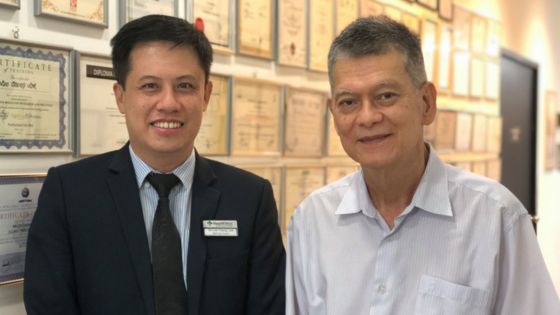
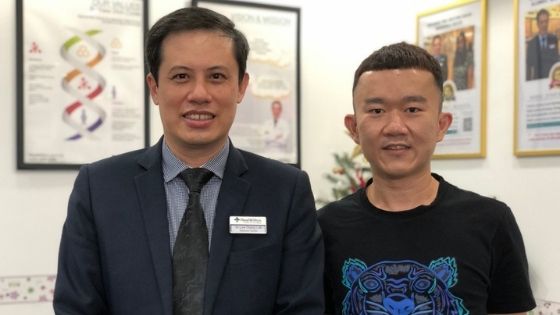
But something remarkable happens during treatment. A patient comes in for their heart condition — and within months, their blood sugar normalises. Their joint pain eases. Their energy returns. They look at me and ask, “Dr. Lee, how did all of this improve at the same time?” The answer lies in a principle that is at the heart of everything we do at Heal Within: most chronic diseases share the same underlying root causes — and when you find and treat those root causes, the whole body heals together. In this article, I will walk you through exactly how this works.
Why Do So Many People End Up With More Than One Chronic Disease at the Same Time?
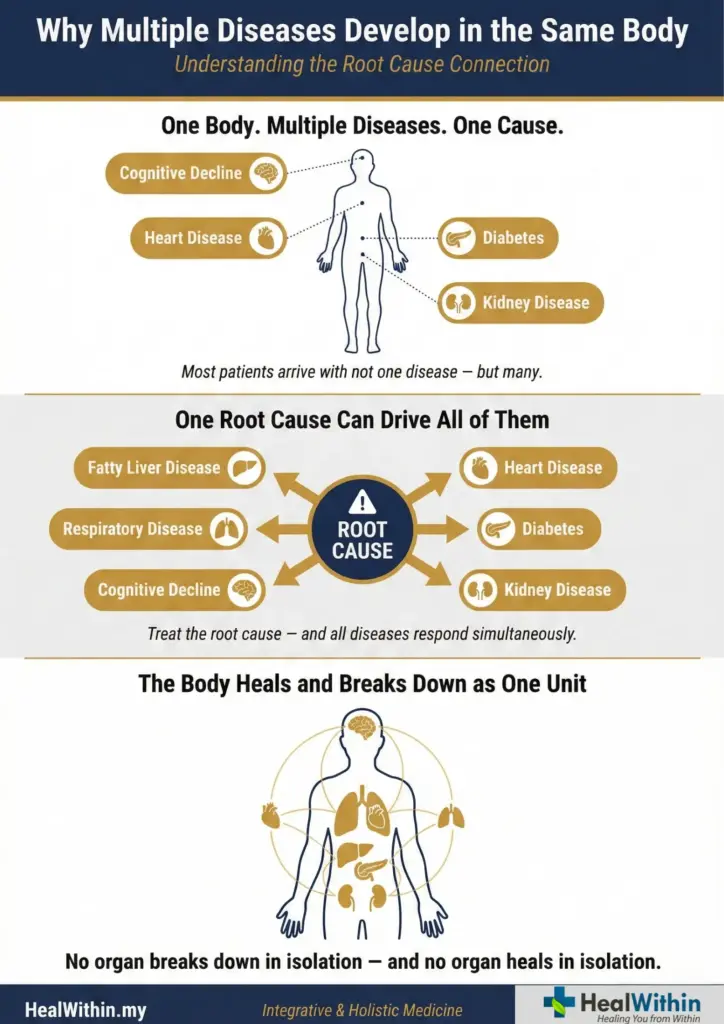
In my clinical experience, it is rare to see a chronic disease patient who has only one condition. Most come to me with two, three, sometimes five or more diagnoses — diabetes alongside hypertension, heart disease alongside kidney problems, arthritis alongside fatigue and poor immunity. This is not a coincidence. There is a clear and logical reason why multiple chronic diseases tend to cluster together in the same person — and understanding this is the first step toward genuine whole-body healing.
THE PATTERN MOST PATIENTS RECOGNISE
For most chronic disease patients, the experience follows a familiar pattern — one diagnosis leads to another over the years, each managed separately, yet none fully resolved.
- A gradual accumulation of conditions: Most patients do not develop five diseases overnight. They begin with one diagnosis, then another follows years later, and another after that — each appearing unrelated, yet all present in the same body at the same time.
- Multiple medications, multiple specialists: As each new condition emerges, a new specialist is consulted and a new medication prescribed. Before long, a patient is seeing four different doctors for what is, in reality, one body in a state of declining health.
- The feeling that something deeper is being missed: Many of my patients arrive at Heal Within with a quiet but persistent sense that their conditions are connected — that treating each one in isolation has never fully addressed what is truly going on inside their body.
WHEN ONE ROOT CAUSE DRIVES MANY DISEASES
What most patients do not realise is that many of their chronic diseases often trace back to the same underlying root causes — and this is precisely why multiple conditions develop together.
- Shared origins, multiple outcomes: A single root cause such as chronic toxin accumulation or persistent nutrient deficiency does not damage just one organ — it creates a biological environment in which multiple organ systems begin to break down simultaneously over time.
- Inflammation as a common thread: Many root causes trigger chronic inflammation throughout the body. This sustained inflammatory state does not confine itself to one organ — it gradually compromises the heart, the kidneys, the joints, the pancreas, and beyond.
- The body’s declining ability to self-regulate: When root causes go unaddressed for years, the body’s natural self-healing mechanisms weaken progressively. This is why patients often find that new conditions continue to emerge even as they are actively treating existing ones.
WHY THE BODY NEVER BREAKS DOWN IN ISOLATION
The human body is not a collection of separate, independent organs — it is one deeply interconnected system, and it heals and breaks down as one unit.
- Every organ system influences the others: The heart, liver, kidneys, immune system, and endocrine system are in constant communication. When one system is under stress, it places a burden on the others — which is why chronic disease rarely stays confined to a single organ.
- Root causes affect the entire biological terrain: Conditions such as heavy metal toxicity, mitochondrial dysfunction, or gut dysbiosis do not target one organ selectively. They alter the biological environment of the entire body, making it fertile ground for multiple diseases to take hold.
- This is why whole-body treatment makes sense: Because the body breaks down as a whole, it must also be healed as a whole. This is the foundational principle behind the integrative & holistic treatment approach we practise at Heal Within.
Why Is It So Difficult to Get All Your Diseases Treated Together Under Conventional Medicine?
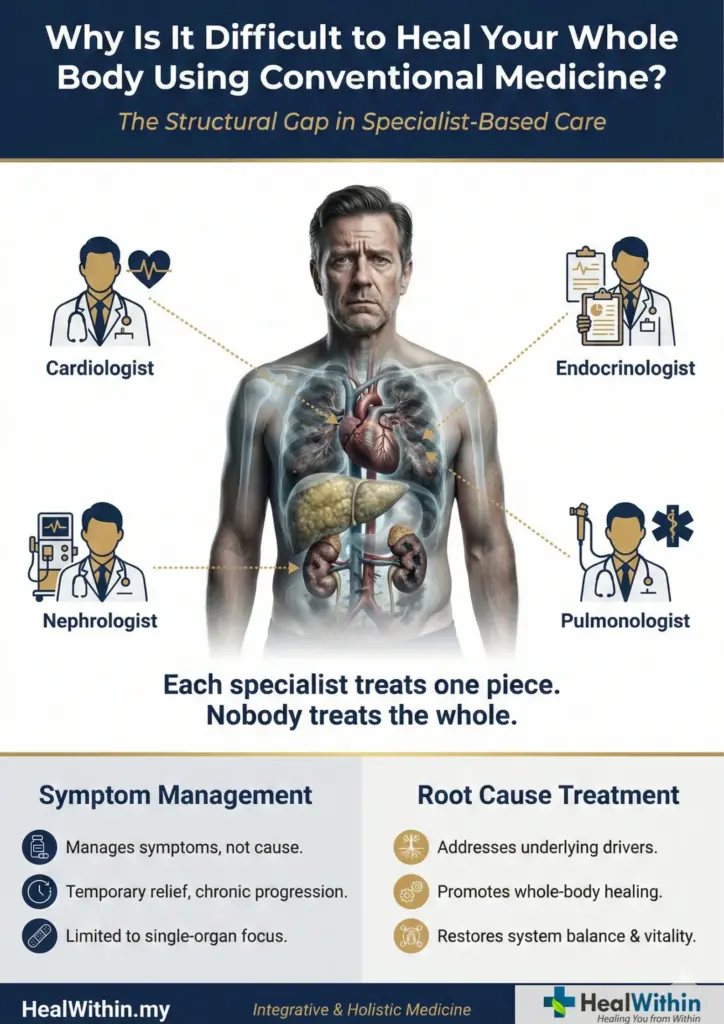
This is a question I am asked often — and it deserves an honest, thoughtful answer. Conventional medicine has given the world extraordinary advances in diagnostics, emergency care, and disease management, and I have deep respect for the doctors who practise within it. However, when it comes to treating a patient who is living with multiple chronic diseases simultaneously, the structure of conventional care presents some inherent limitations that are worth understanding clearly.
THE SPECIALIST SYSTEM AND HOW IT WORKS
Modern conventional medicine is built around specialisation — a system designed to provide deep expertise in individual organ systems and disease categories.
- One specialist, one condition: A cardiologist focuses on the heart, a nephrologist on the kidneys, an endocrinologist on hormones and blood sugar. Each specialist is highly skilled within their domain — but the system is not designed to treat all of a patient’s conditions as one interconnected whole.
- Limited cross-specialty coordination: When a patient is seeing multiple specialists simultaneously, each doctor is typically making treatment decisions based on their own area of focus. A medication prescribed by one specialist may not account for the implications it carries for another organ system being managed by a different doctor.
- The patient becomes the coordinator: In practice, it is often the patient themselves who must navigate between multiple appointments, multiple treatment plans, and multiple prescriptions — without any single doctor holding a complete picture of their whole-body health.
TREATING SYMPTOMS VS TREATING ROOT CAUSES
One of the key distinctions between conventional care and integrative & holistic medicine lies in where the treatment is directed — at the symptoms, or at the underlying causes driving those symptoms.
- Symptom management as the primary goal: In conventional care, the primary objective is often to control or suppress the symptoms of a disease — lowering blood pressure, regulating blood sugar, reducing inflammation. This brings important relief, but it does not necessarily address what caused those conditions to develop in the first place.
- Root causes remain active: When the underlying root causes of a chronic disease are not identified and treated, they continue to drive disease progression quietly in the background — even as symptoms are being managed on the surface.
- New conditions continue to emerge: Because the root causes remain active and unaddressed, the biological environment that gave rise to the first disease continues to deteriorate — which is why many patients find that new chronic conditions develop over time despite being on long-term treatment.
THE MISSING WHOLE-BODY PERSPECTIVE
What integrative & holistic medicine brings to the table is precisely what the specialist system was not designed to provide — a complete, whole-body view of the patient’s health.
- No single doctor owns the whole picture: In a conventional specialist system, no single physician is typically responsible for assessing and treating the patient’s entire body as one interconnected unit. Each specialist treats their domain — and the spaces between those domains can go unaddressed.
- The body’s interconnectedness is often underweighted: Because conventional care is structured around individual organ systems, the profound degree to which every system in the body influences every other system is not always the primary lens through which treatment decisions are made.
- Integrative & holistic medicine fills this gap: At Heal Within, we approach every patient with a single question — what is happening in this whole body, and what are the root causes driving all of these conditions simultaneously? This whole-body perspective, as I explain in detail in this article on why integrative & holistic treatment is necessary, is what makes it possible to treat multiple diseases together — effectively and simultaneously.
How Can Integrative & Holistic Medicine Treat All Your Diseases at the Same Time — and Do So Effectively?
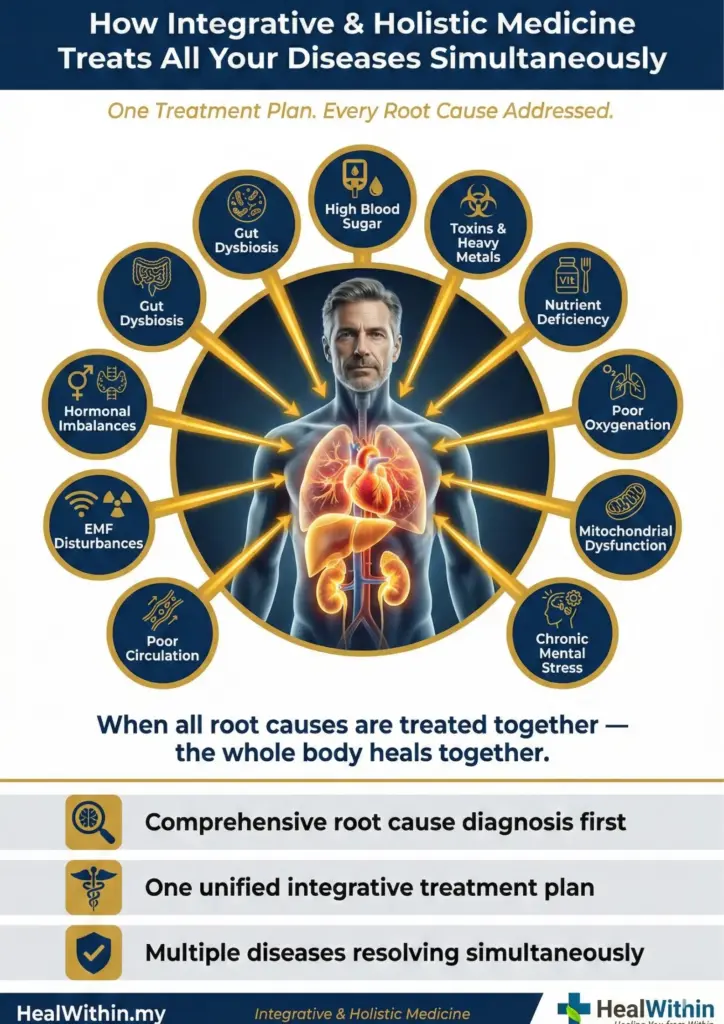
This is where the approach we practise at Heal Within becomes truly distinct. Integrative & holistic medicine is not simply about adding alternative therapies alongside conventional ones — it is a fundamentally different way of thinking about the human body, disease, and healing. When applied correctly, it creates the conditions for multiple chronic diseases to resolve together, because it addresses the shared root causes driving all of them simultaneously.
THE HOLISTIC PRINCIPLE — TREATING THE WHOLE BODY AS ONE UNIT
The word “holistic” comes from the word “whole” — and this is precisely what it means in practice. We do not treat your heart disease and your diabetes as two separate problems. We treat the one body in which both conditions exist.
- The body heals as one system: Because every organ system in the body is in constant communication with every other, healing cannot be truly achieved by addressing one organ in isolation. When we restore the biological environment of the whole body, all organ systems benefit simultaneously — and this is how multiple diseases begin to resolve together.
- Disease is a whole-body signal: In integrative & holistic medicine, a chronic disease is understood not as an isolated malfunction in one organ, but as a signal that the body’s overall biological terrain has been compromised. Correcting that terrain is what produces whole-body healing.
- Every patient is treated as a unique whole: No two patients are the same, even if their diagnoses appear identical. At Heal Within, we assess the entire body — all systems, all conditions, all root causes — and design a treatment plan that reflects the full picture of that individual’s health.
FINDING AND TARGETING THE ROOT CAUSES FIRST
Effective whole-body treatment begins not with prescribing therapies, but with a thorough diagnostic process to identify precisely which root causes are driving the patient’s conditions. As I explain in detail in this article on what treating root causes really means, this step is foundational to everything that follows.
- Root cause diagnosis before treatment: Before any therapy is prescribed at Heal Within, we conduct a comprehensive diagnostic assessment to identify which of the known root causes — such as toxin accumulation, nutrient deficiency, poor oxygenation, mitochondrial dysfunction, or gut dysbiosis — are present and active in the patient’s body.
- One root cause can drive many diseases: When we identify, for example, that heavy metal toxicity is compromising a patient’s cardiovascular function, immune response, and hormonal balance simultaneously, treating that single root cause produces improvements across all three areas at the same time. This is the logic behind simultaneous whole-body healing.
- Root cause treatment produces lasting results: Suppressing symptoms brings temporary relief. But when the root causes driving those symptoms are identified and treated directly, the body’s own healing mechanisms are restored — and the improvements that follow are sustainable, not superficial.
HOW ONE INTEGRATED TREATMENT PLAN ADDRESSES MULTIPLE DISEASES
Once the root causes have been identified, we design a single, unified treatment plan — not a separate plan for each disease, but one integrated strategy that addresses the whole body.
- Integration means strategic combination: The word “integrative” means combining — in this context, combining the most appropriate medical modalities and therapies in a deliberate, strategic way to address all identified root causes simultaneously. Each therapy is chosen not in isolation, but as part of a cohesive whole-body healing strategy.
- Multiple root causes, one treatment plan: A patient presenting with heart disease, diabetes, and chronic fatigue may have four or five active root causes contributing to all three conditions. Our integrated treatment plan is designed to address all of those root causes concurrently — which is precisely how all three conditions begin to improve together.
- The result is synergistic healing: When therapies are combined strategically and directed at root causes, their effects reinforce and amplify one another. The outcome is not merely the sum of individual treatments — it is a compounded healing response that moves the whole body toward restored health, as detailed in this article on why integrative & holistic treatment is necessary.
How Does the Treatment at Heal Within Treat All Your Diseases at the Same Time — and Do So Effectively?
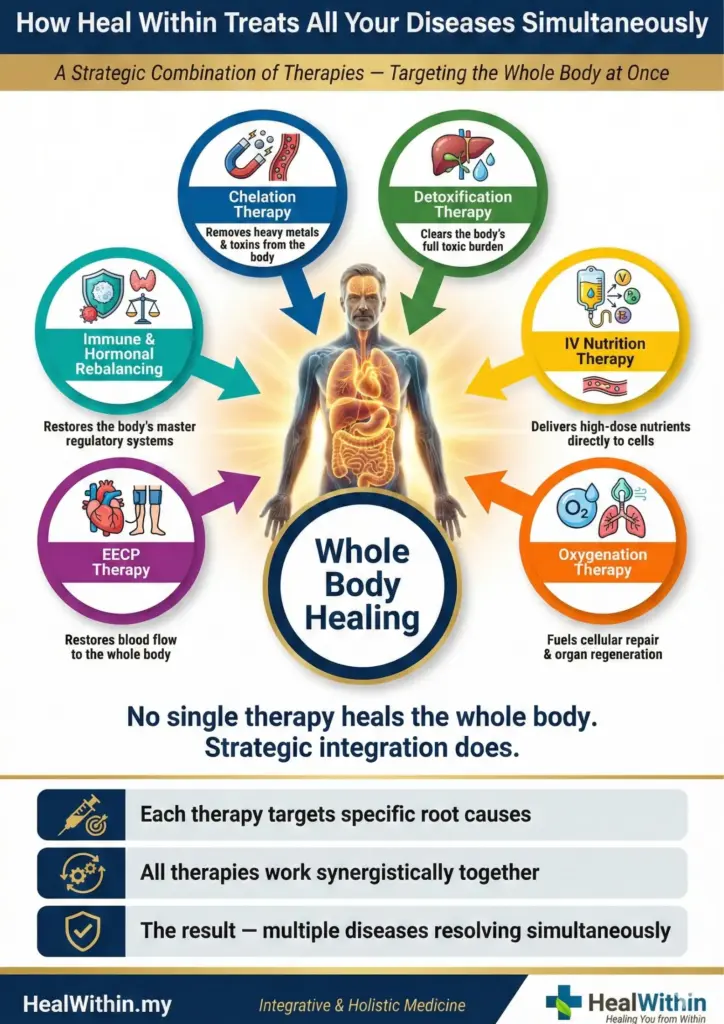
Understanding the philosophy behind integrative & holistic medicine is one thing — but my patients always want to know the practical reality: what exactly happens during treatment, and how does it produce healing across multiple conditions simultaneously? The answer lies in the specific therapies we deploy at Heal Within, and the way in which they are strategically combined to address root causes across the whole body at once. Let me walk you through this in practical terms.
ADDRESSING TOXINS, HEAVY METALS AND CELLULAR WASTE
One of the most significant and commonly overlooked root causes of chronic disease is the accumulation of toxins and heavy metals in the body — and clearing them is often one of the first and most impactful steps in whole-body treatment.
- Chelation therapy — removing heavy metals systemically: Chelation therapy uses specific agents administered intravenously to bind to and remove heavy metals such as lead, mercury, arsenic, and cadmium from the body. These metals accumulate over years of environmental exposure and are a known driver of cardiovascular disease, neurological decline, immune dysfunction, and hormonal disruption — meaning their removal produces improvements across multiple conditions simultaneously.
- Detoxification therapy — clearing the body’s toxic burden: Beyond heavy metals, the body accumulates a wide range of environmental toxins, metabolic waste, and cellular debris that impair organ function across multiple systems. Our detoxification protocols are designed to systematically reduce this toxic burden, restoring the body’s biological terrain and creating the conditions for whole-body healing to take place.
- Why this step affects many diseases at once: Because toxins and heavy metals do not confine their damage to one organ, removing them produces a system-wide benefit. Patients frequently notice improvements in energy, cognitive clarity, blood pressure, blood sugar regulation, and immune function — all as a result of addressing this single root cause effectively.
RESTORING NUTRITION, OXYGENATION AND MITOCHONDRIAL ENERGY
Chronic disease almost universally involves some degree of nutrient depletion, poor cellular oxygenation, and mitochondrial dysfunction — three deeply interconnected root causes that we address together through targeted therapies.
- IV Nutrition therapy — delivering nutrients directly to the cells: Oral supplementation is often insufficient for patients with chronic disease, as impaired gut absorption limits how much nutrition actually reaches the cells. IV Nutrition therapy bypasses this limitation entirely, delivering high-dose vitamins, minerals, antioxidants, and amino acids directly into the bloodstream — rapidly restoring the nutritional environment that every organ system requires to function and heal.
- Oxygenation therapies — fuelling cellular repair: Chronic disease is consistently associated with poor tissue oxygenation at the cellular level. Therapies directed at improving oxygenation — including autohemotherapy — enhance the oxygen-carrying capacity of the blood and the efficiency with which oxygen is delivered and utilised by cells throughout the body, directly supporting the repair and regeneration of multiple organ systems simultaneously.
- Mitochondrial restoration — rebuilding the body’s energy foundation: The mitochondria are the energy-producing units of every cell in the body. When mitochondrial function is impaired — as it commonly is in chronic disease — every organ system suffers, because all cellular processes depend on adequate energy supply. By restoring mitochondrial function through targeted nutritional and therapeutic support, we restore the energy foundation upon which whole-body healing depends.
REBALANCING CIRCULATION, IMMUNITY AND HORMONAL FUNCTION
The final layer of our integrated treatment addresses the body’s regulatory systems — circulation, immunity, and hormonal balance — which govern how effectively the body heals and maintains itself over time.
- EECP therapy — restoring circulation throughout the whole body: Enhanced External Counterpulsation (EECP) is a non-invasive therapy that significantly improves blood and oxygen delivery to all organs by stimulating the development of collateral circulation. Because every organ in the body depends on adequate blood flow to function and heal, improving circulation systemically produces measurable benefits across multiple conditions — from heart disease and kidney function to cognitive health and physical energy.
- Immune system restoration — rebuilding the body’s natural defences: Chronic disease both results from and contributes to immune dysfunction. Our integrated treatment protocols include targeted therapies to restore immune balance — reducing chronic inflammation, strengthening the body’s ability to fight infection, and rebuilding the immune surveillance mechanisms that protect against disease progression and recurrence.
- Hormonal rebalancing — restoring the body’s master regulatory system: Hormonal imbalances are both a root cause and a consequence of chronic disease, and they affect virtually every system in the body — metabolism, cardiovascular function, mood, sleep, immune response, and cellular repair. By identifying and correcting hormonal imbalances as part of the integrated treatment plan, we restore one of the body’s most powerful self-regulating mechanisms — further amplifying the whole-body healing response that the full treatment protocol is designed to achieve.
Summary and Conclusion
What I have walked you through in this article is not a theory — it is the clinical reality of what happens every day at Heal Within. Here are the key principles to carry with you:
- Most chronic diseases in the same patient share the same underlying root causes — which is why multiple conditions so commonly develop together in the same body.
- Conventional specialist care, while valuable, is structured around individual conditions rather than the whole body — meaning the shared root causes driving multiple diseases often go unaddressed.
- Integrative & holistic medicine treats the entire body as one interconnected unit — identifying and targeting all active root causes through a single, unified treatment plan.
- At Heal Within, therapies such as Chelation, Detoxification, IV Nutrition, Oxygenation, EECP, and Immune and Hormonal Rebalancing are strategically combined to address root causes across the whole body simultaneously.
- The result is not the treatment of one disease at a time — it is whole-body healing, where multiple conditions improve and resolve together.
The question I want to leave you with is this — if your chronic diseases share the same root causes, does it not make complete sense to treat those root causes together, rather than manage each condition separately for the rest of your life?
The patients who walk through the doors of Heal Within do not always arrive expecting what they receive. But what they experience — the normalising of blood sugar alongside a healing heart, the return of energy alongside the easing of pain — is not a surprise to us. It is the natural outcome of treating the whole body, the way the body was always meant to be treated.
If you are ready to explore what whole-body healing could mean for you, I invite you to take that first step and reach out to us at Heal Within.