Have you recently come across the words “Integrative & Holistic Treatment” and wondered what they actually mean?
Or perhaps you are already undergoing this form of treatment — but still cannot fully explain to yourself or others why this approach is necessary?
And what makes it fundamentally different from the conventional medical treatment you have always known?
These are questions I hear often — from new patients stepping into Heal Within for the first time, and from existing patients who are already on their treatment journey but want a deeper understanding of the philosophy behind what they are doing. The words “integrative” and “holistic” are used widely today, but rarely explained with the clarity and precision that allows you to truly grasp their meaning — and more importantly, why this approach is not simply an alternative preference, but a biological necessity for anyone seeking complete healing from chronic disease.
In this article, I want to give you that clarity. By the end, you will understand exactly what these two words mean, why the body demands this approach in order to heal, and how this treatment philosophy translates into real, structured, personalised treatment.
What Do the Words "Integrative" and "Holistic" Actually Mean?
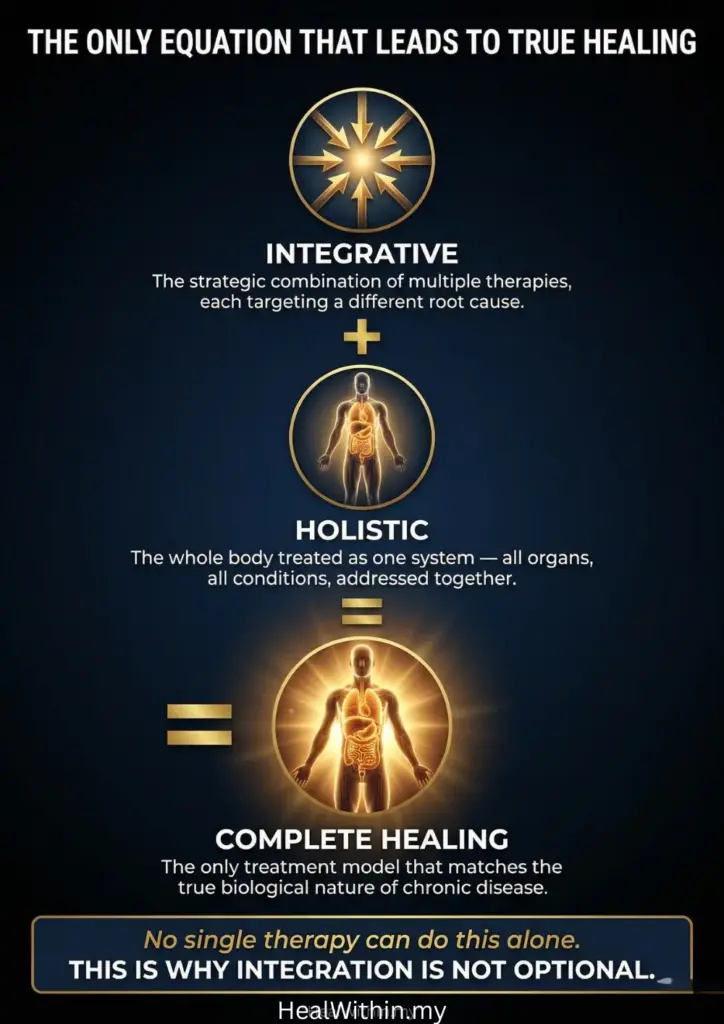
Two words that are used often in modern medicine — but rarely unpacked with the precision that allows you to truly understand what they mean, and why together they form the only treatment philosophy capable of delivering complete healing.
WHAT "INTEGRATIVE" MEANS
The word “integrative” comes from “integration” — which simply means combination. In the context of medicine, Integrative Treatment means the strategic combination of multiple medical therapies and modalities, working together to achieve what no single therapy can achieve on its own.
- Integration is not about using more therapies — it is about selecting and combining the right therapies for each patient’s specific condition, so that every aspect of their illness is addressed in a coordinated, purposeful way.
- No single therapy can resolve all root causes — different therapies address different root causes; chelation targets toxic heavy metals, IV nutrition corrects deficiencies, EECP improves circulation and oxygenation, detoxification clears cellular waste. Each does its part. Together, they restore the whole.
- The combination is always personalised, never standardised — the integration of therapies is tailored specifically to each patient based on their diagnosis, their active root causes, and the specific conditions present in their organs.
WHAT "HOLISTIC" MEANS
The word “holistic” comes from “whole” — whole-listic. In the context of treatment, Holistic Treatment means treating the entire body as one interconnected unit, rather than treating a single disease or organ in isolation while the rest of the body remains in a diseased state.
- The body is not a collection of independent parts — every organ communicates with and influences every other organ through shared blood supply, lymphatic channels, nerve pathways, and hormonal signals. What happens in one system always affects the others.
- Treating one disease while ignoring others is inherently incomplete — when the liver is burdened, the brain suffers. When the gut is inflamed, immunity is compromised throughout the entire body. Isolating one condition for treatment while others remain unaddressed guarantees that healing will be partial at best.
- Holistic treatment addresses all unhealthy conditions in all organs simultaneously — this is what “whole body healing” actually means in practice. Not one disease at a time, but the entire body restored together — as I explain in full detail in Can All Your Diseases Be Treated Simultaneously to Achieve Whole Body Healing, this simultaneous approach is not only possible — it is the correct way to treat.
HOW THE TWO WORK AS ONE UNIFIED TREATMENT PHILOSOPHY
Integrative and holistic are not two separate ideas — they are two dimensions of a single treatment philosophy, each defining a different aspect of how complete healing is achieved.
- “Holistic” defines the target — the whole body; all organs, all conditions, all root causes addressed together as one unified system rather than as isolated problems.
- “Integrative” defines the method — the strategic combination of therapies necessary to reach that target; because restoring the whole body requires tools that work across multiple root causes simultaneously.
- Together, they form the only treatment model capable of achieving complete, lasting healing — holistic without integration lacks the therapeutic range to address all root causes; integration without a holistic target produces fragmented, incomplete results. Both dimensions are essential.
Why Does Your Body Actually Require This Approach to Heal?
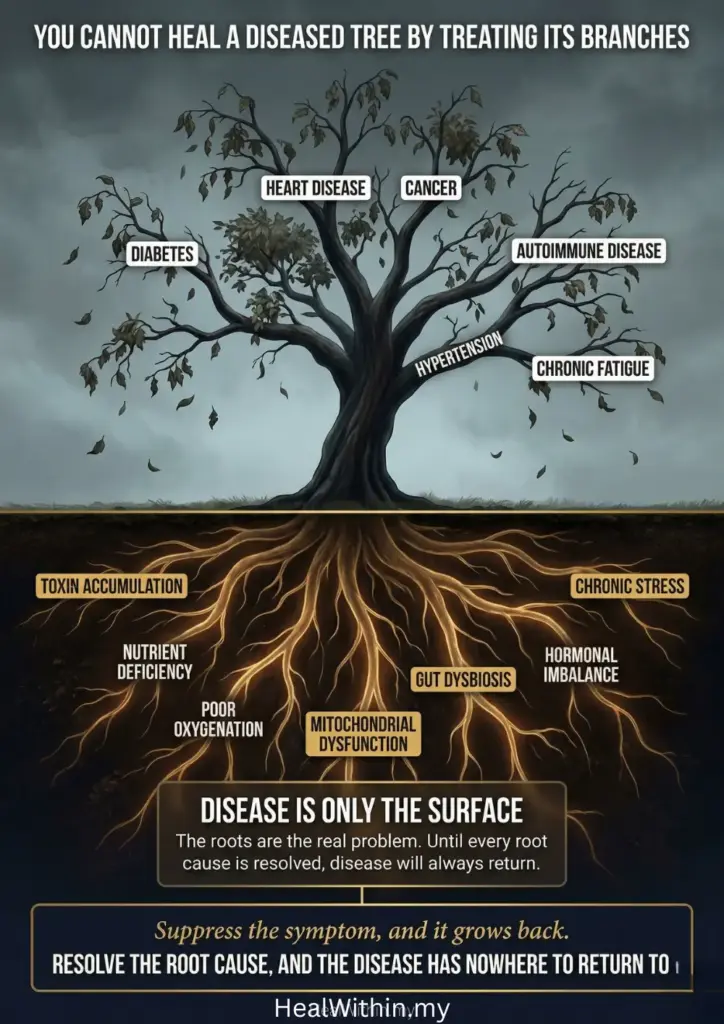
This is the foundational principle — the logical chain that makes Integrative & Holistic treatment not a preference, but an inevitable biological necessity for anyone who wants to truly heal.
DISEASES ARE EXPRESSIONS OF UNRESOLVED ROOT CAUSES
Disease is not the problem itself — it is the visible expression of a deeper, unresolved problem happening beneath the surface.
- A disease symptom is a signal, not a starting point — pain, inflammation, abnormal organ function, and deteriorating health markers are all downstream effects of root causes that have been left unaddressed, often for years.
- Root causes include a range of biological dysfunctions — toxic heavy metal accumulation, essential nutrient deficiency, poor oxygenation, mitochondrial dysfunction, gut dysbiosis, hormonal imbalances, chronic mental stress, and more. Any one of these, left unresolved, will manifest as disease over time.
- Suppressing symptoms while root causes remain active guarantees recurrence — this is precisely why so many patients experience temporary relief followed by relapse. As I explain in What Does Treating Root Causes to Chronic Diseases Really Mean, true healing can only begin when the root causes driving the disease are identified and resolved.
ALL ROOT CAUSES MUST BE ADDRESSED FOR OPTIMAL HEALING TO MANIFEST
Most chronic disease patients are not dealing with a single root cause — they have several active simultaneously. Addressing one while leaving the others untouched means healing can never fully manifest.
- The body functions as one interconnected system — unresolved root causes in one area continuously undermine healing in another. A burdened liver impairs detoxification throughout the whole body. A dysregulated gut weakens immunity systemically. Nothing heals in isolation.
- Partial treatment produces partial results — when even one significant root cause remains active, it sustains the environment in which disease thrives. Complete restoration of health requires that all root causes are resolved, not just the most obvious ones.
- The foundational conditions for healing must all be in place — as I outline in The Healing Essentials: 7 Non-Negotiable Foundations Your Body Needs for Healing, the body has specific biological requirements that must all be met for healing to fully unfold. Remove any one of them and healing stalls.
CONVENTIONAL TREATMENT MANAGES SYMPTOMS — IT DOES NOT HEAL THE BODY
Understanding why conventional treatment falls short is not about dismissing it — it is about understanding why it was never designed to resolve the kind of multi-root-cause dysfunction that underlies chronic disease.
- Conventional protocols are built for single-diagnosis conditions — standardised treatment guidelines are designed to address one identified disease with one corresponding intervention. Chronic disease, by its nature, does not fit this model.
- Pharmaceutical suppression of symptoms leaves the underlying dysfunction completely intact — a medication that lowers blood pressure, reduces inflammation, or controls blood sugar does not remove the root causes producing those abnormalities. The moment the medication stops, the problem returns.
- Most patients feel “treated” but never fully recovered — and this is precisely why — when root causes are never addressed, the body remains in a state of managed dysfunction. Symptoms are controlled, but the disease process continues quietly beneath the surface.
NO SINGLE THERAPY CAN ADDRESS ALL ROOT CAUSES — THEREFORE INTEGRATION IS NECESSARY
This is the logical conclusion that makes Integrative Treatment not a preference, but a necessity.
- Each therapy is designed to address specific root causes — chelation removes toxic heavy metals, IV nutrition corrects cellular deficiencies, EECP restores circulation and oxygenation, detoxification clears accumulated waste, herbal and biological therapies address infection and dysbiosis. No single therapy does all of this.
- Because root causes are multiple, the therapies to resolve them must also be multiple — attempting to treat a multi-root-cause condition with a single modality is like attempting to extinguish a fire with multiple sources using only one stream of water. The fire continues wherever the water does not reach.
- The strategic combination of the right therapies — each targeting a different root cause — is what creates the conditions for complete healing — this is what Integrative Treatment means in practice. Not more therapies for the sake of it, but precisely the right combination to resolve every active root cause in that specific patient’s body.
How Does Integrative & Holistic Treatment Actually Work in Practice?
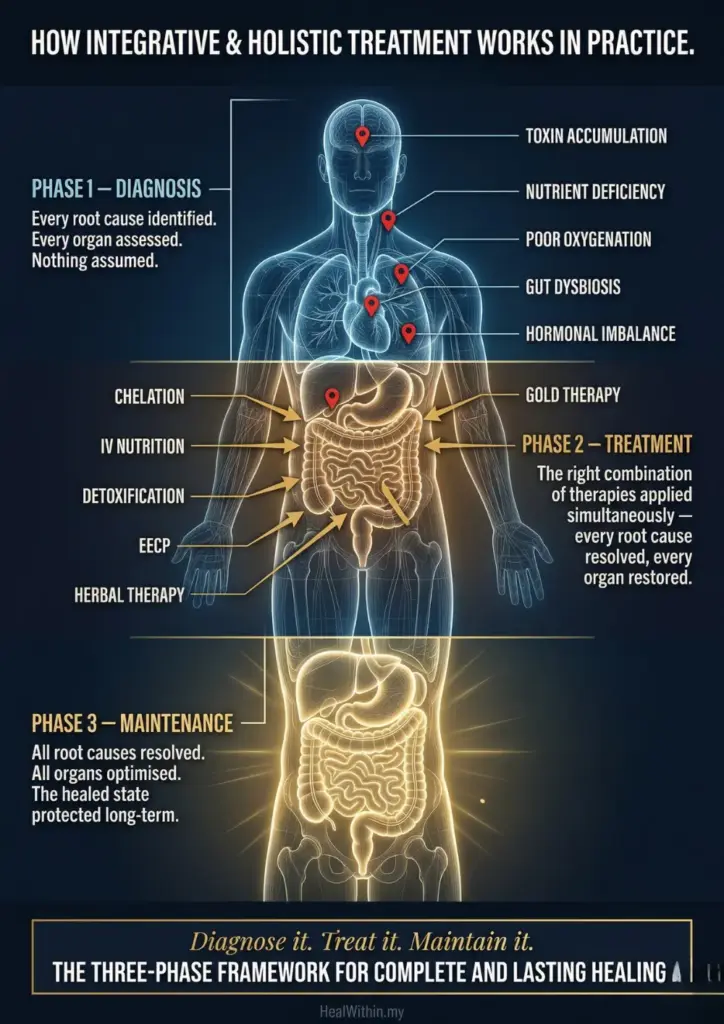
Understanding the philosophy is one thing — knowing how it unfolds in real, structured treatment is what transforms this from an abstract concept into genuine confidence in the path you are on.
PHASE 1 — DIAGNOSIS: IDENTIFYING YOUR SPECIFIC ROOT CAUSES
No two patients arrive with the same combination of root causes. This is why Integrative & Holistic treatment begins not with a standard protocol, but with a thorough, individualised diagnostic process.
- Comprehensive assessment goes far beyond standard medical testing — at Heal Within, diagnosis includes live and dry blood analysis, digital meridian organ scanning, toxicology testing, nutritional status assessment, hormonal profiling, and detailed medical history analysis — all designed to reveal the specific root causes active in that patient’s body.
- The goal of diagnosis is to build a complete picture, not confirm a single disease — rather than identifying one diagnosis to match one drug, the objective is to map every active root cause, every organ condition, and every biological dysfunction that is contributing to the patient’s overall health state.
- The treatment plan is built entirely from the diagnosis — only after this complete picture is established does the doctor design the treatment protocol. Nothing is assumed, nothing is standardised. Every therapy selected has a specific reason rooted in that patient’s diagnostic findings.
PHASE 2 — TREATMENT: ADDRESSING ALL ROOT CAUSES SIMULTANEOUSLY
With the root causes identified, the treatment phase begins — and this is where the integrative approach delivers what no single therapy ever could.
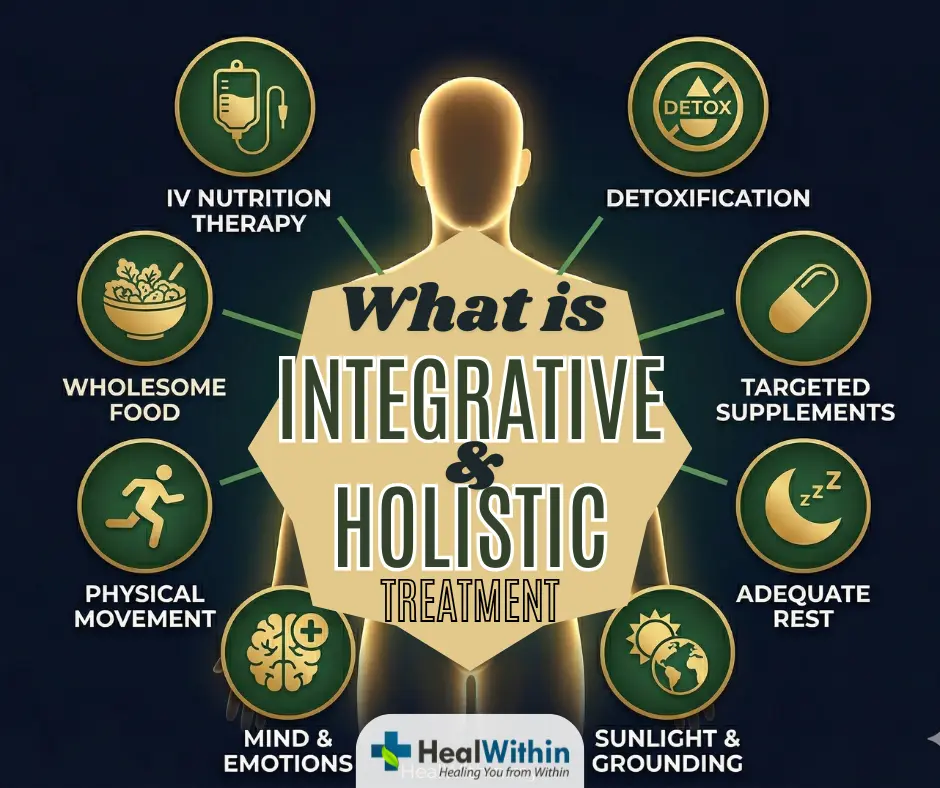
- The right combination of therapies is selected and administered together — chelation for toxic heavy metal removal, IV nutrition for cellular replenishment, EECP for circulation and oxygenation, detoxification therapies for systemic cleansing, and additional modalities as indicated by each patient’s specific root cause profile.
- Therapies work synergistically — their combined effect far exceeds what any one could achieve alone — when detoxification is supported simultaneously by nutritional restoration and improved oxygenation, the body’s healing response accelerates across multiple systems at once. This is the power of strategic integration.
- All diseased organs are treated together, as one body system — not sequentially, not in isolation. As I explain in Can All Your Diseases Be Treated Simultaneously to Achieve Whole Body Healing, treating the whole body together is not only possible — it is the only approach that produces complete, lasting results.
PHASE 3 — MAINTENANCE: SUSTAINING THE HEALED STATE LONG-TERM
Healing is an achievement — but it must be protected. The maintenance phase ensures that the root causes do not return, and that the body continues to function at its optimal level long after active treatment is complete.
- A personalised maintenance plan is tailored for each patient after treatment — this includes wholesome nutrition, full-spectrum supplementation, periodic detoxification, cardiovascular and musculoskeletal exercise, and ongoing monitoring through periodic medical testing.
- Mind and emotional health are a non-negotiable part of long-term healing — chronic mental stress is itself a root cause of disease. As I discuss in Heal the Mind & Emotions, Heal the Body: Why Mental & Emotional Regulation Is a Must, no maintenance plan is complete without addressing the psychological and emotional dimensions of health.
- The objective is not just to prevent recurrence — it is to achieve optimal health long-term — when all the foundational conditions for health are continuously maintained, the body does not merely stay disease-free. It thrives. Energy, vitality, immunity, and quality of life all improve — and continue to improve — over time.
Summary and Conclusion
We have covered a great deal of ground in this article — and every point connects back to one central truth. Chronic disease is not a mystery, and healing from it is not a matter of luck or genetics. It is a matter of understanding what is truly driving the disease, and applying the right approach to resolve it completely. Here are the key principles to carry forward:
- “Integrative” means strategic combination — no single therapy can resolve all root causes; the right combination of therapies, tailored to each patient’s specific condition, is what makes complete healing possible.
- “Holistic” means the whole body — every organ, every condition, every root cause addressed together as one interconnected system — not one disease in isolation while the rest of the body remains diseased.
- Disease is the expression of unresolved root causes — suppressing symptoms without resolving the underlying dysfunctions driving them guarantees that disease will return. True healing begins only when root causes are identified and treated.
- All root causes must be addressed for optimal healing to manifest — partial treatment produces partial results. The body cannot fully heal when even one significant root cause remains active and unresolved.
- Conventional treatment was not designed for chronic disease — standardised, single-diagnosis protocols and pharmaceutical symptom suppression leave the underlying dysfunction intact. This is why so many patients feel managed, but never truly healed.
- Integrative & Holistic treatment is therefore not optional — it is a biological necessity — it is the only treatment model that matches the true nature of chronic disease: multi-root-cause, whole-body, and requiring a strategic combination of therapies to resolve completely.
Every chronic disease patient deserves to understand this — not because it is a philosophy to be debated, but because it is the biological reality of how disease develops and how healing actually works. If you have been on a treatment journey that has left you managing your condition rather than recovering from it, I want you to sit with this question: have the root causes driving your disease ever truly been identified and addressed?
That is where real healing begins — and it is precisely what Integrative & Holistic treatment is designed to do. The body has a profound capacity to heal when given the right conditions. Our work is to create those conditions — completely, not partially.